Leg Day
I haven't needed to say this once since I started CrossFit, but yesterday was "leg day."
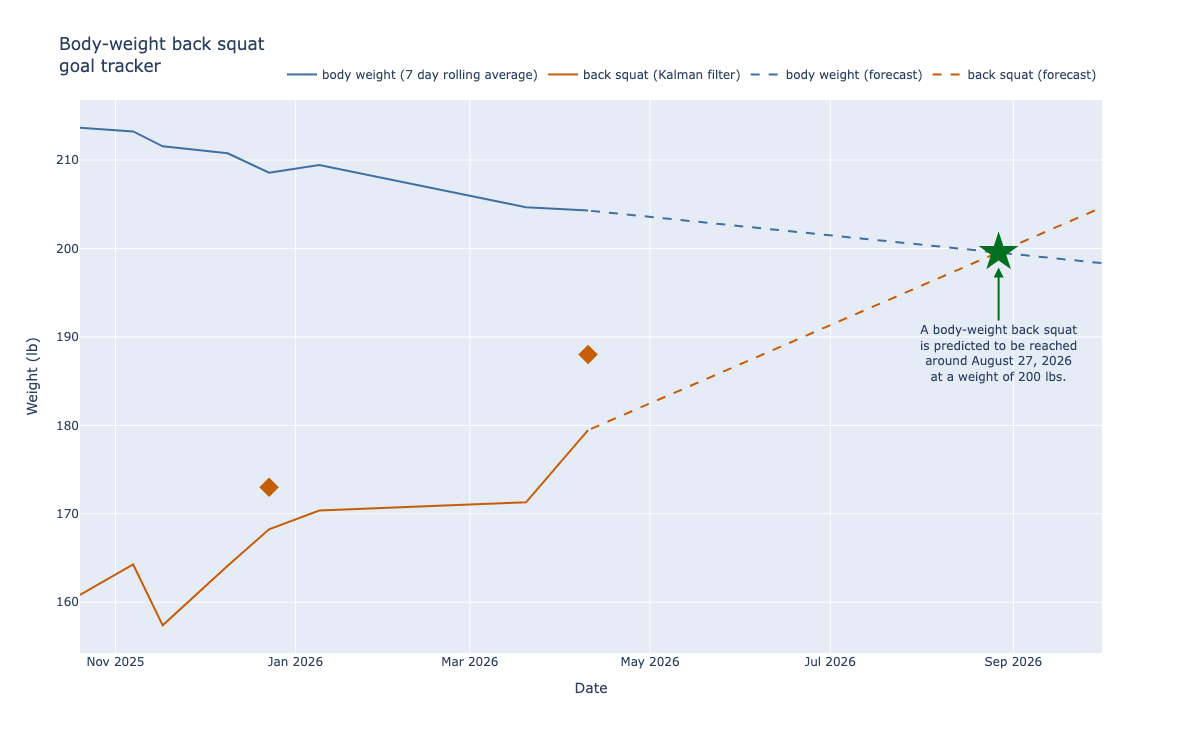
I have been doing CrossFit Linchpin programming for the last seven months and haven't missed a workout (or if I did, it was to swap in an alternative exercise). Pat has been programming monthly fitness tests for the last couple of years that repeat every six months. For the record, these are different from The Linchpin Tests; they are simple enough to fit in well with overall GPP. I've completed all six of them at least once now, and today I finally saw my first opportunity for a retest. And guess what it starts with...a one-rep max back squat! In case you're new, I have a goal of achieving a body weight back squat, so I was very excited to get an opportunity to log a new data point on that track.
Here's the whiteboard for yesterday's WOD:
Checkpoint Delta: "Magic Legs"
Part A
1 rep max back squatRest as needed
Part B
20 min AMRAP:
- 200 m shuttle run
- 10 box jumps @ 20 in
- 2 back squats @ 60% of max (each round add 2 back squats)
I knew I wasn't going to hit body weight, but I wanted to at least go max effort and get as close to a PR as possible. I went hard on this workout. I dedicated at least 20 minutes to warming up and hitting the back squat. I even set up the safety bars so that I could safely attempt to max out. I did attempt to match my recent PR of 193 lbs—it felt a little weird, so I softly bailed and reracked it 5 lbs lighter and hit 188 lbs and called it a day. It was a really good rep and I got it on video.
But oh man, were my legs jello going into the AMRAP. I was excited that I did not fail any box jumps because I was waddling on those runs. And those squats felt so heavy! I finished the round of 10, then tried to sneak in the last run before the time cap. I didn't get all of it in, but I'll give myself credit for half a rep - I ran pretty hard to earn that much.
Quantifiable Results
Many training methodologies have quantifiable results. What's different about CrossFit is that its definition of fitness is designed to be quantifiable, measurable, and repeatable. So of course I'm going to nerd out on my repeat results here. The last time I did this workout, the first part was the same, but the AMRAP was different: 100m run, 5 box jumps, and 1, 2, 3... back squats.
Below is a breakdown of the results from this week and back in October. I'm actually very surprised that I was able to improve in every single category. The only thing that stayed constant was the box jump height.
| Measurement | Oct 2025 | Apr 2026 | Change |
|---|---|---|---|
| 1 RM Back Squat | 183 lbs | 188 lbs | +2.7% |
| AMRAP score (rounds+reps) | 7+11 | 5+0.5 | -- |
| Run distance per rep | 100 m | 200 m | +100% |
| Total run distance | 700 m | 1100 m | +57% |
| Box jump height per rep | 20 in | 20 in | 0% |
| Total box jump reps | 35 | 50 | +43% |
| Total box jump height | 58'4" | 83'4" | +43% |
| Back squat weight per rep | 105 lbs | 115 lbs | +9.5% |
| Total back squat reps | 26 | 30 | 15% |
| Total back squat weight | 2730 lbs | 3450 lbs | +26% |
| Body weight | 215 lbs | 205 lbs | -4.7% |
Average Power Output
Remember from your L1 how to calculate average power output? If you haven't taken an L1, then maybe you remember it from your high school physics class. (Yes, CrossFit uses real physics - I can't tell you how happy that makes me.)
$$ P = \frac{W}{t} = \frac{Fd}{t} $$
Power is work over time. Work is force applied over a distance. We can compute average power by computing the total work done and dividing by total time of the workout. So let's go ahead and compute the change in average power for the AMRAP portion of this workout. We'll want to compute each movement's contribution to the overall workload.
$$ W_{total} = W_{run} + W_{boxjump} + W_{backsquat} $$
We could certainly complicate this equation even further with angles, limb-lengths, weight distribution, air resistance, and biomechanical efficiency, but let's just do some basic napkin math to get a ballpark estimate.
Let's start with box jumps since they are the easiest to calculate. When I jump, I apply force downward with my feet to the floor, and by Newton's third law, that equal and opposite force gets applied to my body. If the force is larger than the force of gravity on my body (i.e., weight), then I will accelerate upward. Another way to think about it is that the work done is equal to the change in gravitational potential energy from standing on the ground to standing on the box: weight times height.
The back squat equation is a little bit trickier but it's the same concept. Gravity does most of the work when I drop down into the squat, but I do all the work to stand it back up. But we're also doing more work than just moving the barbell - I mean, all those air squats in Cindy are work, right? We're also displacing some of our body weight up and down each squat. For simplicity, let's say that amount is half of our total body weight. As for the vertical displacement, I can measure that directly from the videos. I'd say the barbell moved about 2.5 feet from standing to squat (I'm 5'7" for reference).
The run is harder to compute. Recall Newton's first law: an object in motion (or at rest) stays in motion (or at rest) unless acted upon by an external force. If we're jogging along at a constant velocity, i.e., not accelerating, then there is no net force (that's Newton's second law: net force = mass × acceleration). But clearly, we're working when we're running, right? So what's going on here? I said there's no net force — there are multiple forces canceling each other out. There are forces your muscles apply to your limbs to push against the ground and propel you forward; however, there's also a lot of friction during all of that trying to slow you down (I majored in physics, not exercise science — this is as far as I can go in this explanation). So we're doing work when we run, but we aren't doing as much work as a box jump or a squat in order to move the same distance.
I did a little research on how the running world calculates power and learned about the energy cost of running, or ECOR. According to this article by Top End Sports (and references therein), for most athletes, it costs 1.04 kilojoules of energy to move each kilogram of body weight a distance of one kilometer. Don't worry, I'll save you time and convert those units to ones that make sense to you in the end—what is a physics Ph.D. for, after all? One kcal (i.e., the "calorie" used to measure food energy) is about 4 kJ. So if you weigh 80 kilos and you run one kilometer, you'll expend about 20 kcals.
| Measurement | Oct 2025 | Apr 2026 | Change |
|---|---|---|---|
| Total work for running | 17 kcal | 25 kcal | +47% |
| Total work for box jumps | 4.1 kcal | 5.6 kcal | +37% |
| Total work for squats | 4.5 kcal | 5.3 kcal | +18% |
| Total work for AMRAP | 25.6 kcal | 35.9 kcal | +40% |
| Average Power for AMRAP | 89 watts | 125 watts | +40% |
Instead of using the silly unit of foot-pounds, I decided to stick with units that made a bit more sense, like calories for energy and watts for power. We see the numbers become a little less impressive because I accounted for the fact that I effectively shed a 10-lb weight vest in the 6 months between workouts. But the results are fascinating - +40% increase in overall power output in a 20-min workout.
Another reason I like this workout is that it is a good metabolic test. You have the explosive power of the box jumps testing the glycolytic pathway mixed in with the aerobic component of running while also testing muscle endurance. It's a great CrossFit workout for that reason, which makes me even more excited that I improved so greatly.
Predictions
My automated pipeline ran overnight to pull in my latest weigh-in and workout results. After crunching the numbers, it computed a new prediction for my goal of hitting a body weight back squat by late August of this year. It's a little later than what I initially computed when I ran this model a month ago. Since then, my weight loss has plateaued a bit. I'm hoping to accelerate that a bit — my nutritionist had me drop my macros slightly starting this past week. That, combined with an ever-increasing ability to produce more power in each workout, should help increase the calorie deficit needed to see slow, sustainable weight loss.
What's next?
Other than the minor course correction I made with the macros, I'm planning on continuing the same program. Though, I might be testing another lift soon. I saw an advertisement for a charity max deadlift competition at another gym in Chicago in 8 weeks. That seems like the perfect amount of time to fit in a quick cycle.